Walpole,The Valley of The Giants and a Conspicuous Cliff, south west WA (2nd and 3rd November, 2011)

Uh oh we’re in for some stormy weather now for a few days ……its finally caught us again as we travel through the south west corner of WA. The countryside is very green and lovely with more and more trees. Reminded us of England, the only giveaway being the fields of vines (we’re also in wine growing country) and flowering apple orchards……in November!
We head to Karri and Tingle country (the giant Karri Oak and Eucalptus augustus (Tingle) tree forests unique to this part of Australia – that’s why it rains so much!) – land of the giant trees. To Walpole a small town that is located near the so called Valley of  The Giants and home to the Treetop and Ancient Empire walks. We camped at Rest Point on the Nornalup Inlet at Walpole – lovely waterside location but again those pesky darn flies (also mozzies we thought we’d left behind in the tropics!!) and it got a little soggy overnight with thunderstorms….(give us the baking sun of north WA any day)!
We did have a good half day of sunshine the next day to visit the Valley of The Giants and walk the Ancient Empire through the giant tree forests. Amazing trees and some measuring over 70 metres tall!

Pelicans at Nornalup Inlet

Giant Milliipede at Valley of Giants Visitor Centre - no its not real!

A tree with knobbly knees!

Karen in the tree

and in another .......( or maybe out of her tree!)

Its so big I can't see the top!

After getting our (tree hugger) fix on these amazing trees we headed to the coast and to Conspicuous Cliff – beautiful beach and headland with pretty blue flowers, with the conspicuous cliff of course….wonder where the Aussies got that name from?

Paul heading down to Conspicuous Beach

Conspicuous Beach

A Conspicuous Cliff?

Whale spotting at Conspicuous Beach

Posted in Uncategorized | Comments Off on Walpole,The Valley of The Giants and a Conspicuous Cliff, south west WA (2nd and 3rd November, 2011)

To Bunbury, south of Perth, WA ( 31st October and 1st November, 2011)

Onwards we drove four and a half hours further south, steered round Perth (visited in 2001) so that we could get to a city called Bunbury. Bunbury is about 200km south of Perth and regional city on Geographe Bay. It was a useful pit stop for two days whilst we got Hilda serviced and some new tyres (this essential before we drive back east along The Nullabor, around Adelaide and South Australia, and back to Melbourne still 3-4000km away). Bunbury is not the prettiest of places but has some notable features such as a helter skelter lookout hill and chequerboard lighthouse all set on a stunning coastline though!

Chequerboard Lighthouse overlooking Geographe Bay at Bunbury

Karen at Geographe Bay, Bunbury

On top of the lookout - overlooking Bunbury marina

Helter skelter lookout..........hmm!


Posted in Uncategorized | Comments Off on To Bunbury, south of Perth, WA ( 31st October and 1st November, 2011)

Cervantes and The Pinnacles Desert, Nambung National Park, WA (Sun 30th October, 2011)

We camped at Cervantes beachfront on a stretch of beautiful coastline but plagued by loads of pesky flies and native bees (non stinging) ……aagh! Apparently in late Spring as its warming up they hatch out …..great!
Still it was worth the two day visit as the national park had some amazing scenery to view including some massive white sand dunes as well as the strange phenomenon called The Pinnacles. These pinnacles lie in the middle of an inland yellow sandy desert but only 5km from the sea. They are limestone structures made of shells trapped in sediment tubes underground for millions of years (remnant of the ancient marine fringe). As the desert sands have moved and eroded away they have revealed these pinnacles, now jutting out of the landscape. Weird but dramatic.
This desert is also home to some wonderful wildlife including Emus, Bobtail Skinks and the smallest possum in the world called a Honey Possum. This possum is only 8cm long but apparently ( as we did’nt see one!) the male has balls half its body weight and it lives high up in the shrub vegetation – how it climbs up there to get to the nectar with all that weight beggars belief!!

The Pinnacles Desert

Hold onto your hat its a bit windy at The Pinnacles

Kaz and The Pinnacles Rock!

Its Harry Worth...........?

Hey U!

Hey come over ere mu!

Pinnacle Rock groupie!

Karen resorting to head net - no flies on me!

Yes it is a white sand dune .......not snow!

Sand dunes in the early morning sun

Want a crisp?......lunch at Thirsty Point Cervantes


Posted in Uncategorized | Comments Off on Cervantes and The Pinnacles Desert, Nambung National Park, WA (Sun 30th October, 2011)

From Kalbarri to Cervantes – driving south (Sat 29th October, 2011)

Paul had caught a good quota of colourful fish off the Blue Holes Beach at Kalbarri on our last day there. One was particularly blue with yellow fins – we think it was a Blue Groper but not sure. It got thrown back in anyway!

A Blue Groper...!?

We left the sunshine of Kalbarri on Saturday to drive further towards Perth heading towards Cervantes (which is within the Nambung National Park – home to the Pinnacles Desert). On the way we passed Hutt Lagoon known as the The Pink Lake at Port Gregory … this lake is pink due to the naturally occurring betacarotene. Strange but true! The Indian Ocean Highway was fringed with some spectacular sand dunes along the way and some lovely wildflowers amongst the coastal vegetation as well.

No we haven't been on Photoshop it really is a pink lake!

Sand dunes and wildflowers on road to Cervantes


Posted in Uncategorized | Comments Off on From Kalbarri to Cervantes – driving south (Sat 29th October, 2011)

Kalbarri National Park – walking Nature’s Window Trail (25th October, 2011)

Aagh! It rained last night – we’re not used to this!! Today its dry but overcast and there is talk of thunderstorms later……! So its a good day to do some trail walking in the Kalbarri National Park. We set off with friends Nandor and Sarah and hit the park with lunch packed in rucksacks.
Kalbarri National Park covers the lower reaches of the Murchison River covering some 183,004 hectares. The river has cut some magnificent red and white banded sandstone gorges surrounded by vast rolling sand plains clothed in heathland and lots of wildflowers…again we have hit it at the right time as this is mid Spring in WA. We were in for a treat of a day surrounded by a wonderful wild landscape – great!
First stop along a yellow ochre sand track is the Ross Graham Lookout, followed by a walk along a 9km trail called the Nature’s Window loop and then onto the Z Bend….
The lookout caught a magnificent view over the Murchison River Gorge. It reminded us of  what the Grand Canyon must have looked like in its early stages of river erosion but still dramatic in scale.

Posing on the rooftop of the Murchison River Gorge

Over the gorge from the lookout


At least someone is a professional photographer!

We set off on the walking trail to Nature’s Window on a narrow ridge which led us to a track along the escarpment above the river, then down to a route along the river edge. This went on for about 5km before looping back round to the climb back up to Nature’s Window after 9km which took us about 3 hours due to all the photo opportunities and a picnic lunch on the river ledge in between. Nature’s Window itself is a naturally formed hole in a rock right up on the ridge that you can see the river below. A spectacular walk with a mixture of experiences and scales. The National Park is vast ………bit of an understatement because Australia is so vast with so many National Parks its incredible.

Paul at the start of the trail

Rocky overhang

Mucking about in Nature's Window!

The view through Nature's Window

Paul leading the way along the ridge

Rocks and overhangs

Nature's Posy!

Moving along the ridge above the river

Tributary gorges

Eroded away sections reveal the striped colours on the cliffs

Scrambling along the ledges above the river on the trail

River cliffs

Hey you down there

Pretty wildflowers!

Carpets of yellow wildflowers

Its a long way down!

Ochre yellow sand track

More wildflowers!

After our walk we drove further into the park to see a feature called the Z Bend.  This is basically the cut of the river gorge which is probably best seen from the air!

The Z Bend

Uh oh….thunderstorms approaching we’re in for a very stormy night!

Posted in Uncategorized | Comments Off on Kalbarri National Park – walking Nature’s Window Trail (25th October, 2011)

Kalbarri – The Mushroom Rock Trail, WA ( 24th October, 2011)

Kalbarri is a lovely small town on the coast. The campsite was right in the centre (so we could walk everywhere) and right opposite the Murchison River at the point it meets the Indian Ocean. Beautiful and of course great for fishing! We met up with Sarah and Nandor again as we are all making our way down the west coast and back round to Melbourne at more or less the same route and timing.
The lads took the chance to investigate if the were any fish to be had, whilst Sarah and I took a walk along the cliff tops along a route called the Mushroom Rock Trail. This trail wasd fascinating. Not only for the wildflowers and heathland but the coast is made up of soft sandstone of different colours. Here the cliffs are formed as layered sandstone trapping worm like organisms called Skolithos (pipe life tubes that run through the rock). Theses made colourful dramatic cliffs.
We also saw whales way out in the ocean because it was so clam. Too far away to get a good photo though!
We returned to check on the lads and just as we left them to go back to the campsite Paul hooked out a big 4lb Snapper – which was duly sorted for tea!

Tubes running through rock

More tubes!

Rocks!

Sarah on the coastal trail

Mushroom Rock!

Where the Murchison River meets the Indian Ocean at Kalbarri

Paul fishing off the rocks - just before he caught a big one!

Posted in Uncategorized | Comments Off on Kalbarri – The Mushroom Rock Trail, WA ( 24th October, 2011)

From Monkey Mia to Kalbarri – and some Stromatolites on the way, WA (23rd October 2011)

We wrenched ourselves away from Monkey Mia basking in sunshine, to head further south to Kalbarri. The journey was very interesting with lovely wildflowers (all in bloom) on the road side and we narrowly missed getting a photo of an Emu with her five young Emus. They shifted sharpish when Hilda approached!
We also called in at the Hamelin Pool Stromatolites ( just as we left the Shark Bay World Heritage Area). These strange phenomena are in one of only two locations in the world (the other being Bermuda). These living marine Stromatolites are the oldest living organisms on the planet. They are over 3.5 billion years old. The unique saline environment of this area protects them as they are formed by layers of bacteria and algae trapping layers of sediment growing to form rocky platforms. When they dry out they die and leave black crusty rock platforms. The living ones lie in the shallow water as small towers protected by the intense salinity of the sea. Absolutely amazing! Their location was so quiet and tranquil, all we could hear was the water bubbling nothing else. We walked on a raised boardwalk suspended over the water so that we could see them at close quarters.

Dead Stromatolites

Living Stromatolites

Karen at the Hamelin Pool Stromatolite boardwalk

Looking at the Stromatolites from the raised boardwalk

Wildflowers on the road to Kalbarri

Where's those Emus!


Posted in Uncategorized | Comments Off on From Monkey Mia to Kalbarri – and some Stromatolites on the way, WA (23rd October 2011)

Louis Peron National Park and Cape Peron, Shark Bay ( 22nd October, 2011)

The four of us took a 4WD trip into Louis Peron National Park which is to the north of Monkey Mia running on a peninsula to the Shark Bay Marine Park. This area was named after French Zoologist Louis Peron who discovered it in 1801. We had to deflate the car tyres at a special tyre station at the entrance to the park due to the soft sandy nature of the tracks.
The park is pristine with striking red sand dunes giving way to white sandy beaches. The vegetation is mainly low ground cover juniper with wonderful wild flowers. The marine life is very special and no wonder its a world Heritage Area – it ticks all the boxes and is so pristine its breathtaking!
We drove up to Skipjack Point at the northern most point, so named because of the Golden Trevally fish ( also called Skipjacks). The sea there was alive with fish, turtles, dolphins and Manta Rays. We were very lucky to witness a Manta Ray skim out of the water – it was magical. No photo though as it happened so quickly and a moment like that might not come again. We have never seen the sea so alive and rich with marine creatures. Hundreds of Cormorants ( Aussies call them Shags) were waiting along the shore line and on rocks – no wonder with so many fish it was like the fish counter at the local Fishmongers!
We then drove back along the 4Wd track to Cape Peron itself with more Cormorants and then Bottle Bay for a picnic lunch, and so the lads could get a quick fish in. Typically this is the allocated fishing zone and of course no fish to be had unlike Skipjack Point!

Paul, Nandor and Sarah at Skipjack Point

Waiting for dinner

Karen at Skipjack Point viewpoint over bay

Boardwalk at Skipjack Point

Cape Peron and red sand dunes

Lining up for a spot of lunch - fancy fish today lads?

Blending in with the colours

Track into the National Park

Goana narrowly escaping being squashed by the car!

Reinflating the tyres after the sand tracks at Louis Peron NP

Traditional wind turbine at the Peron Homestead Precinct outside the national park entrance

We then reinflated the car tyres and had a quick look at the Peron Homestead Precinct (old sheep station – now a museum to the National Park). A fantastic trip with great company! Later Sarah and Nandor had a meal at the restaurant back in Monkey Mia for their wedding anniversary. We sneaked them a bottle of bubbly via the waitress to help them celebrate which gave them a pleasant surprise (by way of thanks for taking us in their 4WD too!).

Posted in Uncategorized | Comments Off on Louis Peron National Park and Cape Peron, Shark Bay ( 22nd October, 2011)

Blue Lagoon Pearl Farm, Monkey Mia ( 21st October, 2011)

Paul and Nandor went fishing so Sarah and I had a trip on a 40 foot catamaran to see where the unique black pearls of this area are cultivated at the floating Blue Lagoon Pearl Farm in the bay. The lads were’nt interested in seeing pearls, the chance to catch fish was too great (even though it was Nandor and Sarah’s 28th Wedding Anniversary the next day … Sarah took along the credit card anyway as apparently there was a shop on board!).
The pearl farm was on a floating platform and we were shown how they insert the seed pearl into the oyster (apparently it gets inserted into its male parts (together with a piece of the Nacra  – the pearl coating) – this is to stop it rejecting the pearl! This process is very tricky like surgery done in sterile conditions mostly by Japanese technicians who can earn up to $5000 a day! Each insertion process has to be done in less than 45 seconds to avoid killing the oyster ( I’m sure the oyster would prefer it if it was even less than that!).
It then takes 11 years to form a pearl. The black pearl is unique to this area due to the shell coating being multi coloured so ‘black’ could also mean a range of colours. The white pearls of Broome are due to the larger shells with white Nacra coating inside. The pearl guide also told us that they inserted gold, opels and artificial shapes like dolphins and heart shapes so that the Nacra formed a pearl covering to create pendants etc.

Blue Lagoon Pearl Farm

It goes in here!

Results of gold and opel inserts with pearl covering

The trip was fascinating and to cap it all we then got a trip further out into Shark Bay to find some Dugongs (Sea Cows) and other creatures. The Dugongs proved to be a little elusive – they are brown come up for air like whales and dolphins but are shy and because they have no dorsal fin its tricky to spot them, they surface and dive before you can blink, so by the time you press the camera shutter they’ve gone man solid gone! We did see more dolphins who show off of course and played around the boat. They certainly love the camera!

Dolphins racing the boat

Follow me!

We did see some camels back on the beach but still not tempted to do the Lawrence of Arabia bit! The lads had just finished fishing when we returned but no catch of the day!

Hey they must have followed us from Broome!


Posted in Uncategorized | Comments Off on Blue Lagoon Pearl Farm, Monkey Mia ( 21st October, 2011)

Dolphins but no Monkeys at Monkey Mia, Shark Bay, WA (19th – 22nd October, 2011)

After three days at Carnarvon we all packed up, stocked up on provisions and headed down to Monkey Mia of dolphin fame. The drive there was quite spectacular given how windswept and flat it is along this coastal highway. The landscape to the road into the peninsula of Shark Bay changed to low level pines with some beautiful spring flowers ranging from whites to pinks and mauves mostly with pom pom like heads waving around in the wind!
Monkey Mia sits on Shark Bay in a World Heritage Area. The bay is the largest in Australia and home to a unique seagrass ecosystem with high saline levels attracting all sorts of marine life including the Dugong (Sea Cow). We called in at a town called Denham which was very windswept and then onto Monkey Mia.
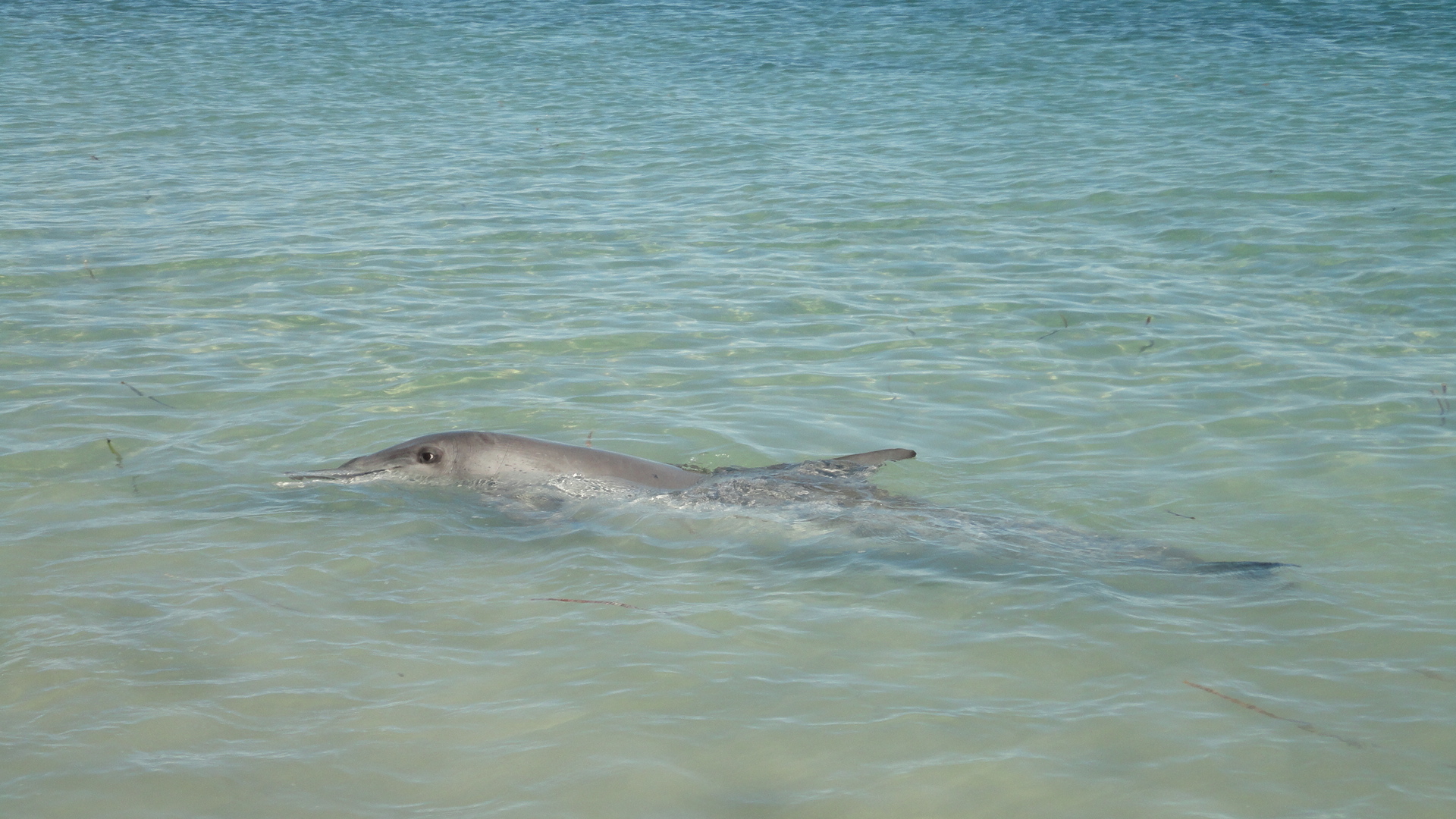
First morning we dashed out to see the dolphins which arrive to get fed at 8am. It was wonderful to see them but a little commercial and staged with every person at the resort campsite out in force, but these creatures are so delightful to see so it did’nt matter.

Paul fishing and keeping cool at same time at Monkey Mia

Dolphin no 1 at Monkey Mia

Eh up!

Okay enough showing me off where's me fish now?

Lets play!

Posted in Uncategorized | Comments Off on Dolphins but no Monkeys at Monkey Mia, Shark Bay, WA (19th – 22nd October, 2011)

Blowholes, cliffs and fishing tales – Quobba Bay ( north Carnarvon) (18th October, 2011)

Nandor and Sarah caught up with us at Carnarvon and we all had a great day trip out to look at the Blowholes at Quobba Station. Quobba lies south of the Ningaloo Reef where the sea deepens off the end of the reef shelf with steep cliffs off the land with these distinctive blowholes (formed as the sea pushes up through small holes and fissures in the rock). Paul and Nandor had also been told that because this was at the end of the reef with deep waters close to land, that big fish such as tuna, marlin and mackerel could actually be caught off the land from these cliffs. A special technique was needed though involving helium balloons tied to dead mackerel bait, a really big hook on a stick and the need to harness yourself on to avoid being pulled in and becoming shark bait. The lads were up for it…….but as you can imagine Sarah and I were’nt too keen! We promised to go and sus it out with a view to getting the equipment only if it looked suitable……
So off we went to have a look…….luckliy the sea was so angry looking and cliffs steep and slippery that the lads decided maybe it was’nt a good idea and would stick to fishing off the beach…phew! Maybe next time!?

Karen and Sarah at Blowholes cliffs

Sarah and Nandor at Blowholes

Paul at Blowholes

Err lads there's no way you're fishing here!!

Blowholes in full force - stand back!!

A safer mode of fishing at Quobba beach....!

Salt pans at Lake Macleod on way back from Quobba


Posted in Uncategorized | Comments Off on Blowholes, cliffs and fishing tales – Quobba Bay ( north Carnarvon) (18th October, 2011)

Carnarvon (without the castle), WA (16th – 18th October, 2011)

Leaving the rugged beauty of Coral Bay we headed south to a town called Carnarvon (not like the Welsh one and it certainly had no castle) on Sunday 16th October. The weather now getting cooler and we know it is likely we will start to see some rain as we get nearer to Perth having been sunfried and frizzled for the last two months. Not complaining though as we know that when we return to the UK early next year it will certainly make up for it!!
Carnarvon lies within the main fruit and vegetable growing region of WA and supplies about 70% of western Australia’s fresh food. The distinctive banana plantations are in contrast to the arid land we have driven through. Carnarvon is also home to One Mile Jetty built in 1897 for ships to come close into land to link with the railway station there, to take livestock and wool to Perth. The railway is now closed with relics of old engines and the old lighthouse cottage is converted into a museum. All fascinating stuff!

The bay at Carnarvon

My other car's an old relic!

Karen at One Mile Jetty

Hilda getting a much needed wash at the Carnarvon camp site


Posted in Uncategorized | Comments Off on Carnarvon (without the castle), WA (16th – 18th October, 2011)

Coral Bay……..and a shark nursery on the south Ningaloo Reef, WA (13th to 15th October, 2011)

We left Exmouth and headed further south to Coral Bay (at the southern end of Ningaloo Reef) which we had been told is another beautiful spot with more reef to explore, white sand and shallow crystal clear water. Another long drive along a very windswept road but it was worth it. The bay was lovely and great for kids as the beach was flat and the water shallow for 30-40 metres out. Unfortunately, we had caught the tail end of the WA school holidays so the campsite was bursting at the seams but the beach was so long there was room for everyone and more!
The reef was further out and in much deeper water with less fish to see but the coral formation was like giant cabbages…..and luckily no sharks! We did walk along the full length of the bay round to the headland and came across a shark nursery in a shallow inlet! There must have been at least 20 juvenile Tiger Sharks ranging in size from 1 metre to over 2.5 metres just swimming in the shallows. We did’nt like to venture in case their mums were about….but it was amazing to see such creatures just a few metres from the beach. We also saw blue spotted stingrays in the shallows as well, and were told that someone had stood on one the previous day and had got badly stung by its tail…….well you would be pretty annoyed if someone stood on you! We did’nt fancy getting too close in case it was still annoyed!

Coral Bay with reef beyond

Coral Bay beach

Just keep your distance buddy!!

Shark infested waters!!

Its a mini jaws!!

This Puffer Fish has seen better days!

Drink plenty of this!

Posted in Uncategorized | Comments Off on Coral Bay……..and a shark nursery on the south Ningaloo Reef, WA (13th to 15th October, 2011)

Turtles, Fishing, and Ningaloo Reef revisited – Cape Range NP, WA (12th October, 2011)

Another day in the national park. A beautiful blue sky today made Turquoise Bay even bluer than our previous visit. We did’nt see any sharks this time but saw multi coloured fish, starfish and giant clams ………it was wonderful and a privilege to see it all.
Later that day we caught up with Nandor and Sarah. The lads fished off the beach (they caught loads but all too small for eating apparently!) at Lighthouse Bay campsite whilst Sarah and I went turtle spotting. We saw two Loggerhead turtles one hitching a ride on the other……..but the waves were so strong they knocked them apart!!

Paul in snorkelling mode

Karen in snorkelling gear at Turquoise Bay

Paul and Nandor in fishing mode at Lighthouse Bay

Nandor hooks a colourful one!

Two Loggerhead Turtles riding the waves

Phew glad I got him off my back!!

Posted in Uncategorized | Comments Off on Turtles, Fishing, and Ningaloo Reef revisited – Cape Range NP, WA (12th October, 2011)

Cape Range National Park, Ningaloo Reef…..and some reef sharks! (10th October, 2011)

A rare overcast and slightly drizzly day but we headed to explore Cape Range National Park and a closer look at Ningaloo Reef. Firstly heading to the furthest point on sealed road to Yardie Creek Gorge. This gorge is the only one that links with the sea and we walked along its cliff tops to see the rock wallabies and cockatoos that nest on its ledges. the desert flowers are amazing and we are lucky enough to see the Desert Pea (Sturt Pea) as it is now Spring.

Yardie Creek Gorge Cape range NP

Yardie Creek looking back to the ocean

The Desert Pea

We then headed back along the Cape road to look at Turquoise Bay where you can drift snorkel along the Ningaloo Reef. Basically you enter the water at one end of the bay and the current lets you drift over the reef to the other end. Despite it being overcast the bay was spectacular and the name Turquoise Bay fits the colour of the water and the reef is absolutely wonderful. We got on our wetsuits (as the water is still cool) and complete with fins and masks we headed on on the drift of the current. The marine life was incredible and as good as the Great Barrier Reef …….we saw fish in every shape, size and colour including Nemo……and to cap it all we saw two Reef Sharks! One was about 10 metres away swimming away from us but the other was directly underneath me luckliy it was busy poking its head under a reef outcrop but to be on the safe side I kicked fins quickly towards the beach Paul following swiftly behind. Apparently they won’t go near you but we did’nt like to ask it just in case! What an amazing experience to see such marine animals. We intended going again before we leave on Thursday.

Turquoise Bay and Ningaloo Reef

Ningaloo Reef off Turquoise Bay....must get an underwater camera!!

When we got back to the campsite we were treated to a spectacular rainbow at sunset which turned the site pink as the rain clouds started to clear!

Rainbow over Lighthouse campsite

Posted in Uncategorized | Comments Off on Cape Range National Park, Ningaloo Reef…..and some reef sharks! (10th October, 2011)

Exmouth and Ningaloo Reef, WA (7th to 12th October, 2011)

Ar last we reached Exmouth gateway to Ningaloo Reef. Exmouth is on a peninsula which is one of the driest places in the world with Ningaloo Reef (home to whale sharks, humpback whales and coral reef only metres from the beaches) at nearby Cape Range National Park. The humpback whales can be seen offshore but just too far for the camera to get them in view unfortunately.
We stopped for two nights in Exmouth itself to stock up on provisions and then moved out to Cape Range National Park at the Lighthouse campsite for four nights (where there is nothing but wilderness).  The coastline here is amazing with an abundance of wildlife not just associated with the reef but emu and kangaroos everywhere including one roo that nearly came a cropper when it bounced out in front of Hilda just missing us by inches!
There are also turtles including loggerhead and green turtles that come up the beach at high tide at night to lay their eggs. Apparently the temperature of the sand that they bury the ping pong ball shaped eggs determines whether they will be girls or boys. These turtles can be seen in the shallow waters along the beaches.
The fishing is good too, Paul caught several Coral Salmon just a bit small for the pan but fun catching them anyway. And there is a shipwreck called Mildura where we saw more turtles swimming.

Looking for whales at Lighthouse lookout

Mildura Wreck off beach at the Lighthouse

Its a Coral Salmon

Eh up its a turtle head!

Posted in Uncategorized | Comments Off on Exmouth and Ningaloo Reef, WA (7th to 12th October, 2011)

Point Samson (near Dampier of Red Dog film fame), WA (5th-6th ) October, 2011)

Following the coast further south we discovered a great fishing spot at Point Samson north of  the town of Dampier where they filmed Red Dog. Point Samson is a small town based on a fishing fleet so we thought luck might be on our side for some catches ourselves. The Cove campsite was right next to the beach and rocks and we ended up camping next to a couple we had met up with in Howard Springs, Darwin called Nandor and Sarah Hajdu (who had emigrated to Australia with their respective parents from Yugoslavia back in the 1970’s). They are also travelling down the west coast eventually ending up in Melbourne where they live. They are great company. Nandor also likes to fish, having about six rods secreted away in their caravan much to Sarah’s bemusement as she is’nt keen on fishing at all.  So once the various fishing rods were rigged the lads disappeared off to some of the rocky outcrops to see what they could catch on days one and two!
Our luck was in on the second day as Paul caught three Seabream which were big enough to eat. I was supposed to keep an eye on them as we were keeping them alive in the bucket but one escaped luckily within an enclosed rock pool, but it could shift (as it must have thought its luck was in) as I tried to catch it chasing it round this pool, managing eventually to grab it prickly fins and all!. Paul later duly gutted and cleaned them, we rubbed some herbs into the skin and had a tasty feed for tea. They were delicious!

Paul and Nandor fishing off rocks ......day one

First catch for the pan!

Posted in Uncategorized | Comments Off on Point Samson (near Dampier of Red Dog film fame), WA (5th-6th ) October, 2011)

Down to Port Hedland, WA (4th October, 2011)

We were aiming for Ningaloo Reef but this was over 900km away with not many great spots along this stretch of coast so an overnight stop at Cooke Point campsite at Port Hedland had to be done as we still had a few problems with the power to our fridge so a visit to a refrigeration electrician was the main aim for the stopover. Luckily he sorted it as we thought it was okay after getting it resolved at Darwin. Port Hedland is an iron ore mining town and port. Not pretty but the property prices are incredibly high apparently and land is a premium.

Big ships at Port Hedland


Posted in Uncategorized | Comments Off on Down to Port Hedland, WA (4th October, 2011)

Heading down the west coast of Australia, Eighty Mile Beach camp, WA (1st-3rd October, 2011)

As we leave Broome the distances down the west coast between places are long and the road straight with flat arid landscape skirting the edge of the Great Sandy Desert. We find one of the only campsites along this stretch of coast off the main highway along a badly corrugated dirt track which challenged Hilda a bit ( eggs in fridge survived being scrambled though!).  The trip was worth it though as the campsite was wild and beautiful (despite many of its palm trees being devastated by a cyclone in 2009) and the beach was amazing but it was very windy over the two days we stayed whipping up some big surf.
Eighty Mile Beach is renowned for its white sand and fantastic variety of seashells and we found some beauties especially at low tide when the tide went out as far as 1km.
Paul tried fishing but the wind, waves and some pesky seagulls trying to get the prawn bait mean’t no catch.

She sells seashells at 80 Mile Beach

A collection of shells from 80 Mile Beach

Get off me bait!!


Posted in Uncategorized | Comments Off on Heading down the west coast of Australia, Eighty Mile Beach camp, WA (1st-3rd October, 2011)

Broome first stop on the west coast, the Indian Ocean, WA (27th-30th September, 2011)

At last we reach fresh sea air after the arid landscape of t’outback. Broome is a small booming tourist town on the coast of the Indian Ocean, with the beautiful Cable Beach (of camel fame) with its white sand and blue sea.
We camped at Cable Beach a little way out of Broome and staying for a few days before we head south down the coast towards Perth ( still 2000 km away!). Cable Beach is beautiful at sunset and also known to be the best spot to view the staircase to the moon. This natural phenomenon only occurs when the moon is full and its reflection on the ocean is reputed to look like stairs leading to the moon. Unfortunately, the moon was only a crescent when we were there so we did’nt see it! We did see some lovely sunsets though and had fish and chips on the beach to watch the sun go down, which was great. We decided to give the Lawrence of Arabia impressions on camels a miss though luckily the starting point for the rides was a few km away!

Karen at Cable Beach (flip flops in hand)

Watching the sun go down at Cable Beach

Sun going down and falling into the sea!

Broome is also famous for its pearl industry. During the late 1900’s Japanese divers were recruited to using cumbersome copper diving suits, weighted boots and helmets to dive to the deep waters where the pearls lay. They were known as the Pearl Luggers. Many Chinese also came here and there is a small Chinatown community in Broome still today. Broome is an attractive town with its historic corrugated iron clad pearl lugger warehouses used today as gift shops and retail pearl outlets. The biggest pearl in the world is housed here. The world’s oldest outdoor picture gardens is also here.

Aha me hearties its a pearl lugger!

and another P lugger!

The biggest pearl in the world!

Broome is home to lots of sea shells too!

The oldest picture gardens in the world

Broome's Chinatown quarter


Posted in Uncategorized | Comments Off on Broome first stop on the west coast, the Indian Ocean, WA (27th-30th September, 2011)